Confused Deputy: Google IdP Universal Account Takeover via Device Code Flow Hijacking
TL;DR
This one started from setting up the YouTube app on my PS5. The device authorization grant (RFC 8628) it uses, the flow TVs, consoles, and CLIs rely on when they don't have a browser of their own, turned out to hide two stacked bugs in Google's implementation.
Two bugs stack together. First, the session that anchors a device-code sign-in is fully transferable: copy the sign-in URL from one browser to another and the second browser's login satisfies the first device's poll. Second, the authorization server never binds client_id and scope to the device_code server-side, so both can be swapped in the URL after the fact. Chain the two together with the prompt=none parameter and any link, opened by a victim who has ever used "Sign in with Google" anywhere, silently hands over an access token for an arbitrary Google-registered client, no click, no consent screen, no 2FA prompt, almost no trace in the victim's account activity.
Reported to Google's VRP on Feb 25, 2026, initially closed twice as "won't fix": social engineering, reopened after a one-click PoC, fixed by Mar 28, 2026, and rewarded $13,337. Details on that back-and-forth are in the disclosure timeline below.
1. Intro
Most of the well-known attacks on OAuth go after the client or the resource server: a malicious app, an open redirect, a signing-algorithm mix-up. They leave the authorization server itself alone, because it's the one party in the protocol that's supposed to be unshakeable, the thing every other trust decision is anchored to. This is a story about going after that assumption directly, in the one corner of OAuth that's explicitly designed to let the login happen on a completely different screen: the device authorization grant.
It started as a mundane afternoon setting up a TV app on a game console, and it ended with a way to silently take over accounts on virtually any site that offers "Sign in with Google." Getting from one to the other took two separate findings stacked on top of each other, a rejected report, and a fix to the fix. What follows is that story, roughly in the order it actually happened, blockers included.
2. The Device Authorization Grant
Most OAuth flows assume the device asking for access has a browser sitting right there to redirect through. RFC 8628 exists for the case where it doesn't: a smart TV, a games console, a headless CLI. The shape is different from the usual redirect dance:
- The device calls the authorization server directly (
POST /device/code) and gets back adevice_code(secret, stays on the device) and auser_code(short, shown on screen). - The device displays the
user_codeand tells the user to go to a URL,google.com/devicein Google's case, on any other browser. - The user opens that URL on their phone or laptop, types the code, signs in, and consents.
- Meanwhile the device has been polling
POST /tokenwith itsdevice_code. Once the user finishes step 3, the next poll returns an access token.
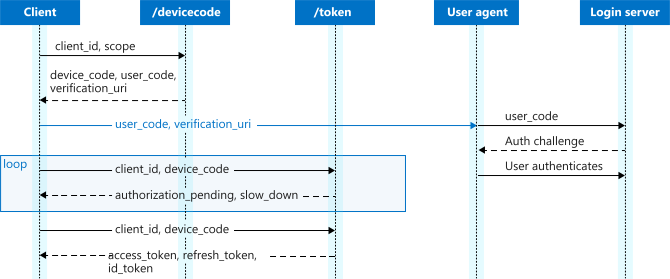
The whole point of the design is that the device and the browser doing the authenticating can be, and usually are, two completely different pieces of hardware. That's also exactly what makes this flow interesting to attack: the protocol already expects the login to happen somewhere else. The only thing holding the model together is that the "somewhere else" has to be a browser the legitimate device owner is sitting at.
That's the assumption. The rest of this write-up is what happened when I went looking for the place where Google's implementation stops enforcing it.
3. Setting Up YouTube TV on a PS5
I was setting up the YouTube app on my PS5, ordinary first-run setup. The console has no keyboard and no way to type a password comfortably with a controller, so it does the sensible thing: it shows a short user_code on screen and tells you to go sign in on your phone instead. I typed the code into google.com/device, signed into Google, approved the consent screen, and a few seconds later the PS5 was logged in.
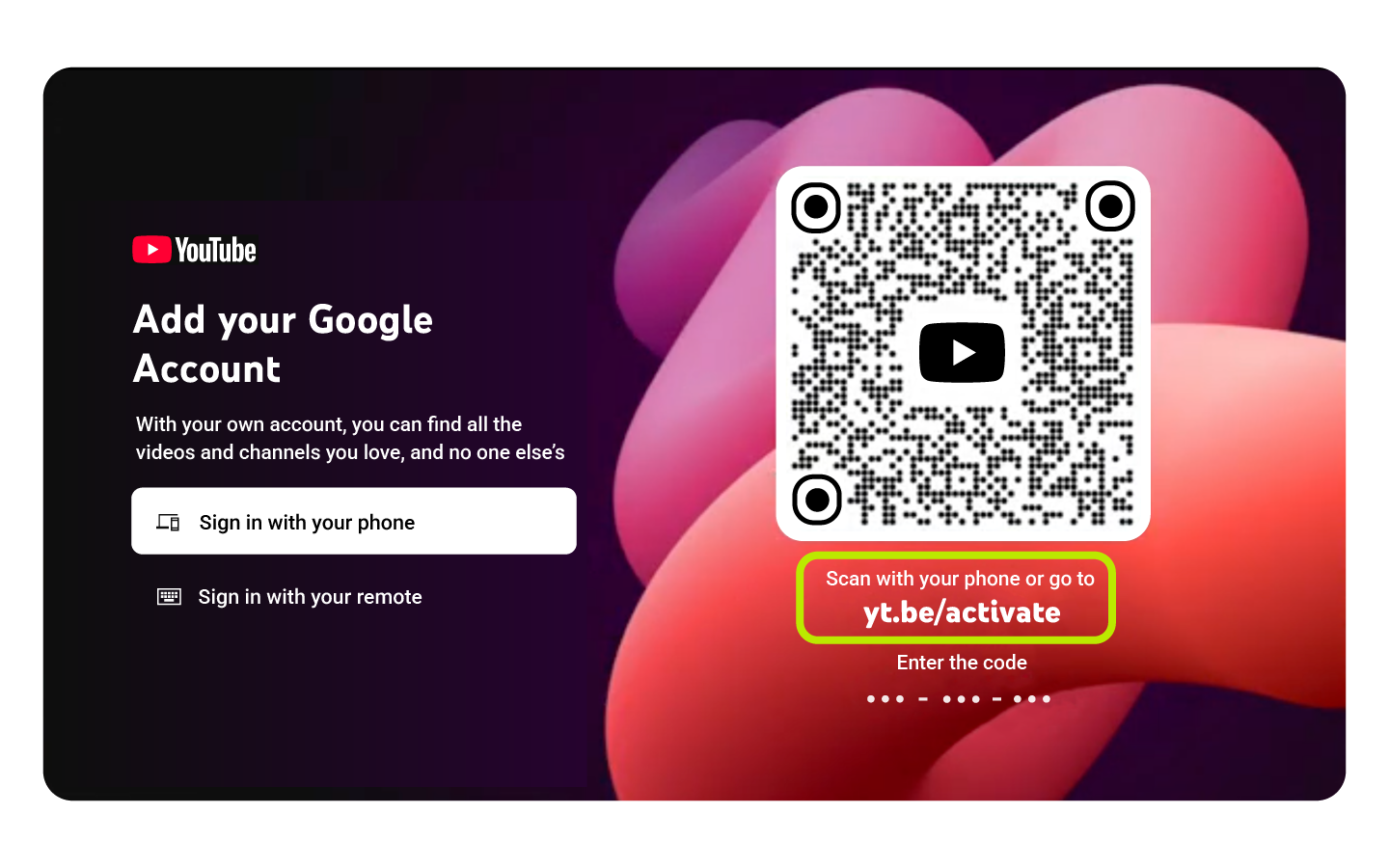
Nothing about that felt unusual as a user, but the flow itself was intriguing: a screen with no keyboard asking me to authenticate on a completely separate device, and coming back logged in seconds later. That disconnect between where I typed my password and where the session actually landed is what made me want to look at it more closely. Behind the scenes, that's:
POST https://oauth2.googleapis.com/device/code→device_code+user_code.- The PS5 polling
POST https://oauth2.googleapis.com/tokenwith thatdevice_code. - My phone's browser walking through
https://accounts.google.com/o/oauth2/v2/auth?…to finalize consent once I typed the code and signed in. - The PS5's next poll returning an access token.
Standard, boring, RFC-compliant. The interesting part is what that accounts.google.com/o/oauth2/v2/auth URL is actually carrying, and what happens if you don't treat it as disposable. That question is exactly what kicked off everything that follows.
4. The Transferable Session
The obvious question with any flow where "the state lives in a URL" is: what happens if you just move the URL? If the entire sign-in step for a device_code can be handed to someone else, then whoever finishes that sign-in step ends up logged into my device, not theirs.
RFC 8628 §5.4 anticipates exactly this and tells implementers not to let it happen: the whole security model of the flow depends on the user completing verification on a device they're not about to lose control of.
I started a fresh device flow on the PS5, walked through google.com/device on a laptop, and at the consent screen copied the resulting URL into a second browser. That failed outright: no session for the second browser to pick up.
But the device-code page asks for an email address before showing consent. Entering one forwards the browser to a different endpoint entirely: a challenge page at accounts.google.com/v3/signin/challenge/…, carrying a new parameter, TL=APouJz6T…. Sending that URL to a second browser worked. The second browser prompted a completely normal Google sign-in. Seconds after logging in, that account showed up on the PS5.
TL is an encrypted blob carrying the session state, practically certain to be the device_code, or something that resolves to it, given that it's the only thing left in the URL that could anchor the poll back to a specific device.
Vulnerability #1: the device-code sign-in session is transferable via URL. RFC 8628 explicitly says it shouldn't be. Send the link, get the account.
That's a real account takeover, but a narrow one. YouTube TV's scopes are capped by design, and that cap is the wall I hit next.
5. Breaking the Scope Fence
A YouTube TV account takeover is real, but Google fences the device flow to a short, deliberately low-risk scope allowlist. Per Google's own docs: "This OAuth 2.0 flow supports a limited set of scopes." The complete list:
openid,email,profileyoutube,youtube.readonlydrive.appdata,drive.file(app-scoped Drive only, not full Drive)
No Gmail, no full Drive, no cloud-platform, no compute. The access token I got only worked against a YouTube TV–internal API: enough to like a video or subscribe to a channel. Not exactly a headline bug.
So I looked again at the transferable challenge URL:
accounts.google.com/v3/signin/challenge/…
  ?TL=APouJz6T…              <- encrypted session state
  &response_type=none
  &client_id=861556708454-…   <- YouTube TV
  &scope=…                    <- YouTube scopes
Two things stand out. response_type=none means this isn't a normal code/token redirect: there's nothing coming back to a callback at all. And there is no redirect_uri anywhere in the URL. The entire boundary that OAuth normally relies on to pin where a grant goes is simply absent from this endpoint, because the grant never gets delivered through the browser; it gets delivered out-of-band, over the device's /token poll.
The only thing anchoring the session is TL. client_id and scope are just along for the ride in the query string. So: keep TL, swap client_id for a different application, and see which client the authorization server ends up authenticating.
I scripted the device-code issuance, took the resulting URL, and changed client_id from YouTube TV to Google's own Cloud SDK client, with scope changed to cloud-platform, compute, appengine.admin. The consent screen that came back said Google Cloud SDK, listing the elevated scopes. Approving it, my polling script, still polling with the original YouTube TV device_code, got back a token on its next call. Inspecting it: cloud-platform, compute, appengine.admin. Not YouTube.
Vulnerability #2: the server never validates that the client_id and scope in the authorization URL match what the device_code was actually issued for.
Combined with vulnerability #1, the authorization server ends up issuing tokens under one client's identity (Google Cloud SDK, or any other Google-registered client, first- or third-party) for a session that started under a completely different one (YouTube TV). redirect_uri isn't just weakly validated here: it's not present at all, because the grant never travels through a redirect in this flow to begin with.
The escalation chain worked end to end, at least on paper. Only one step was left: telling Google about it, and finding out whether they'd agree it was a bug at all.
6. From Consent Screen to One Click
I filed this as a report. It came back rejected the next day, citing user interaction: the victim "consented." Fair, in a narrow sense: the consent screen is genuinely rendered by Google, the click is a genuine click. But the thing being consented to was shaped entirely by parameter substitution in a link I built, and from the victim's side there is nothing to notice that's different from any other Google sign-in. Still, "user interaction" was the stated bar, so the next step was removing it.
OAuth has a prompt parameter for exactly the case of skipping the consent screen: set to none, it tells the authorization server not to show any UI if the user has already granted the requested scopes to that client before. It's meant to be narrow, restricted to low-risk scopes like openid, email, profile, and gated on prior consent.
In practice it isn't narrow at all. "Sign in with Google" is everywhere, and most people have already granted openid email profile to dozens, sometimes hundreds, of apps over the years without ever thinking about it again.
Take the weaponized device-code URL, drop in Facebook's client_id (any site using "Sign in with Google" works the same way), set scope=openid email profile, add prompt=none. The victim opens the link, and that's the only action required: no consent screen, no button to press. The browser silently completes the flow in the background, the polling script receives an id_token for that third-party application, and that token replays cleanly against the app's own "Sign in with Google" endpoint.
One link. Opening it is the only interaction required. Account takeover on virtually any application that uses Sign in with Google.
The technical bypass was solid. What I didn't know yet was whether any of it would actually be visible, to the victim or to Google's own monitoring, if it were used for real.
7. Why the Victim Never Notices
The natural follow-up: surely something surfaces to the victim: a login alert, a new entry under connected apps, a 2FA prompt? It doesn't, and that's not incidental. Every signal that would normally catch this gets routed around by the shape of the device-code flow itself.
Audit trail pollution. myaccount.google.com/connections shows the original client bound to the device_code, YouTube TV, never the substituted application. To find any trace of the attack, a victim would have to open the connections page, scroll to find "YouTube TV" among however many connected apps they have, click into it, click "see details" to expand the granted scopes, and then recognize that YouTube TV requesting cloud-platform / compute / appengine.admin is not normal. Five deliberate steps and a piece of domain knowledge very few people have.
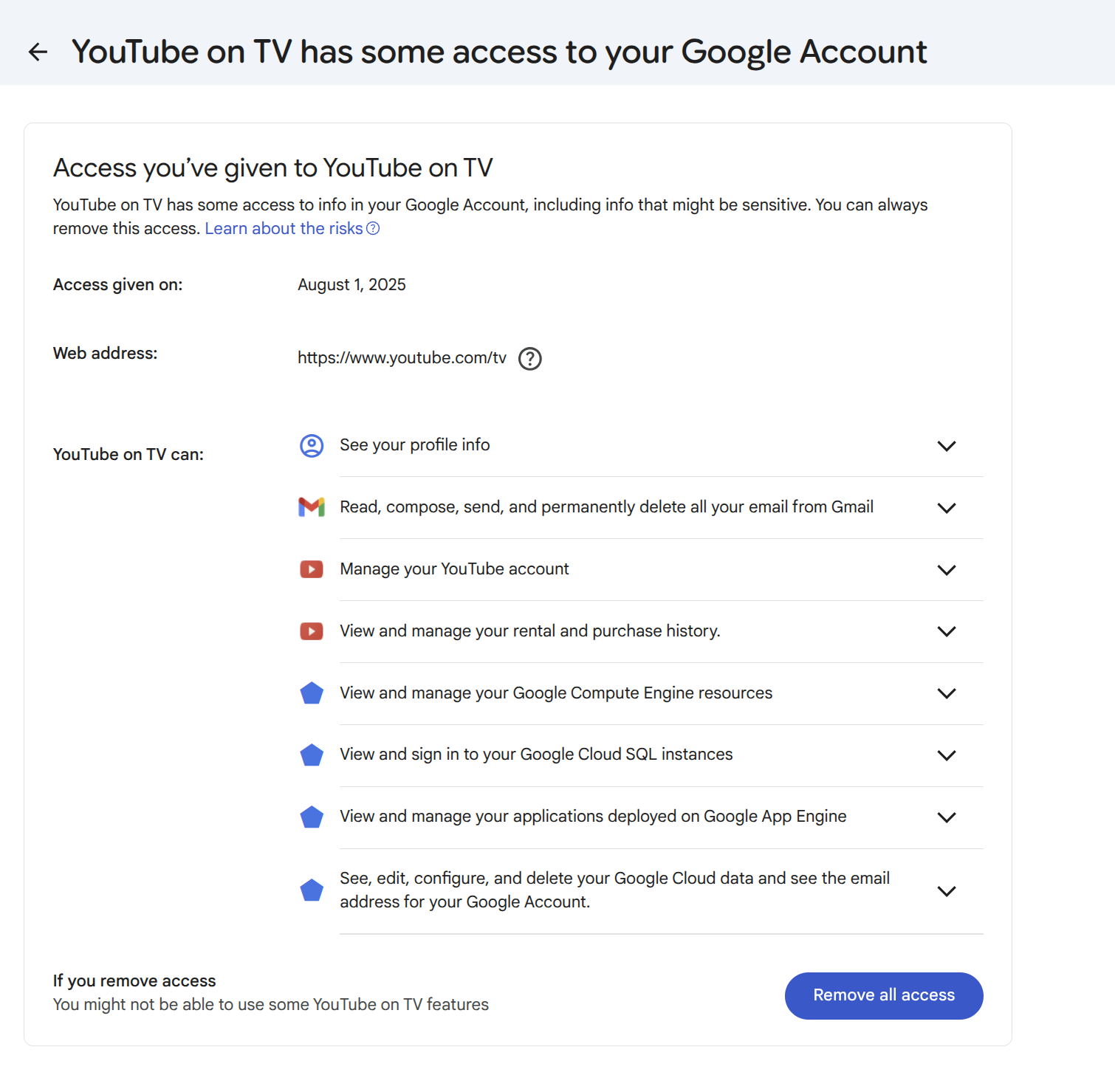
Implicit 2FA bypass. The victim goes through a completely ordinary Google sign-in, which already satisfies any 2FA they have configured. The token handoff to the attacker happens afterward, over the device poll, with no further prompt of any kind. The actual high-risk action, an OAuth grant under an arbitrary client's identity, never trips a high-risk challenge, because as far as the authentication layer is concerned, nothing risky happened; a user just logged in normally.
Stealth, solved. The remaining question was reach: how far the same substitution trick could be pushed past YouTube TV's own scopes.
8. Extending the Primitive
Stealth is one axis; reach is the other. The same client_id/scope substitution keeps paying out against different corners of the Google ecosystem.
Persistent access via accounts.reauth. Add that scope to the substitution and the resulting grant can refresh indefinitely, with no further victim interaction required: a shoot-and-forget backdoor rather than a one-time token.
A Gmail backdoor via IMAP, not the REST API. Substituting a client_id that's allowed to request https://mail.google.com (Apple's iOS Mail client, for instance) gets a token scoped to full Gmail access. Hitting the Gmail REST API with it fails: "Gmail API has not been used in project 861556708454 before or it is disabled." That project ID belongs to YouTube TV, and the original device-code client never had the Gmail API enabled. That's a project-level gate, not a token-level one, so it's worth checking whether there's another door into the same mailbox. Gmail's IMAP server supports OAuth via the XOAUTH2 SASL mechanism, using the exact same https://mail.google.com/ scope but going through imap.gmail.com:993 instead of the REST API's project-gated surface. It accepts the token without issue. Full inbox access, with the same token the REST API had just rejected.
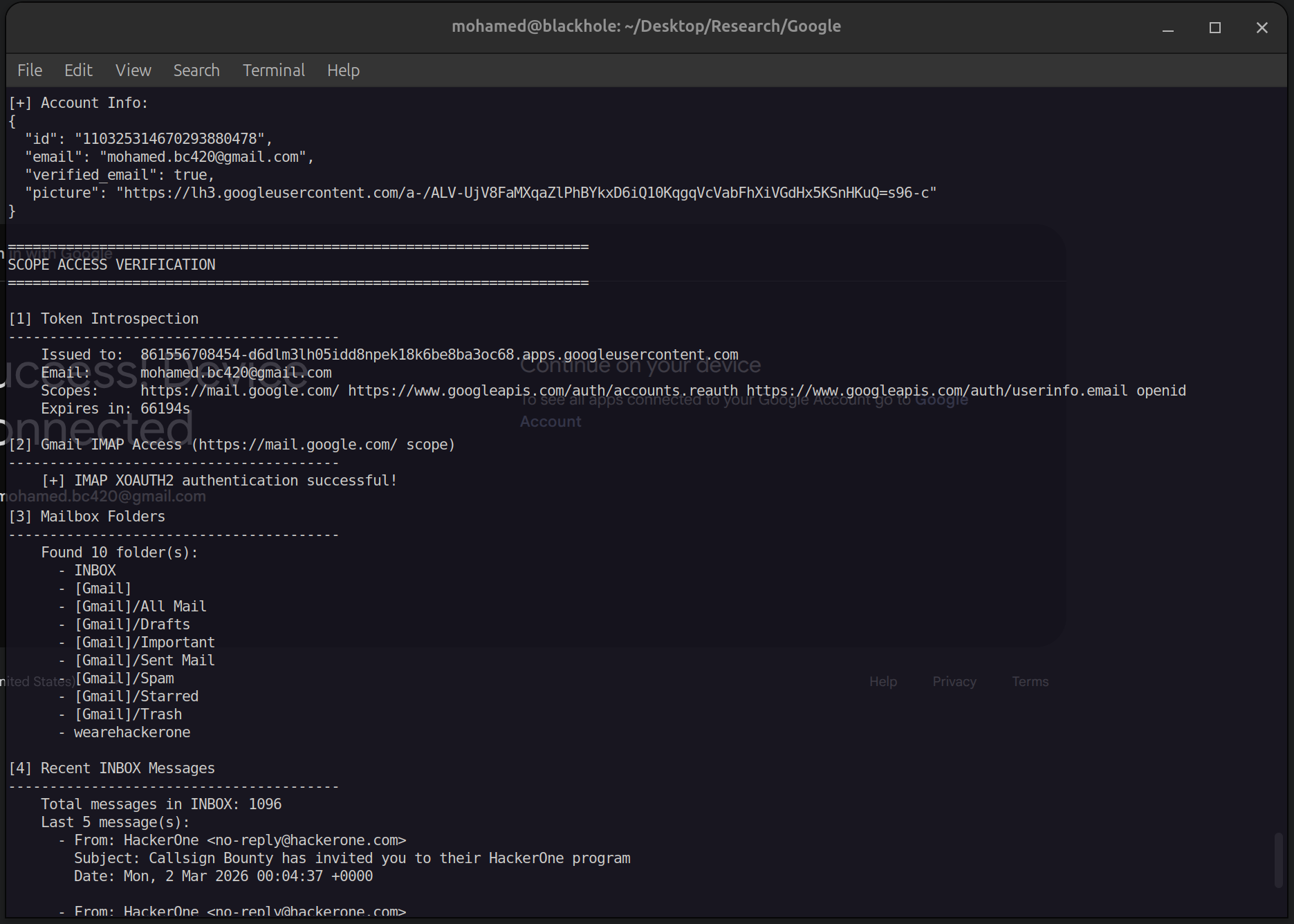
End to end: a transferable session, plus unvalidated client_id/scope binding, plus prompt=none, equals a link that's invisible to the person who opens it and ends in a fully compromised account, Gmail included.
Chain complete: transferable session, unbound client_id/scope, prompt=none, silent to the victim, and a Gmail backdoor at the end of it. Time to see what Google's VRP panel made of all that.
9. Disclosure Timeline
| Date | Event |
|---|---|
| Feb 25, 2026 | Report filed with Google VRP |
| Mar 2, 2026 | Closed: Won't Fix (Intended Behavior), citing "social engineering" |
| Mar 2, 2026 | Pushed back same day |
| Mar 3, 2026 | Reopened, then closed again: Won't Fix (Infeasible) |
| Mar 3, 2026 | Countered with a prompt=none one-click PoC against Facebook's client_id |
| Mar 4, 2026 | Reopened a second time and accepted; bug filed with the product team |
| Mar 28, 2026 | Marked fixed |
| Apr 2, 2026 | Rewarded $13,337 |
The two rejections both leaned on the same argument: that tricking a user into approving an OAuth prompt is a social-engineering problem, not a vulnerability in Google's implementation. That didn't hold up on either pass. The first rejection ignored that this is the exact sign-in flow every Google user already knows, on accounts.google.com, arriving at an app that has no business holding cloud-platform or appengine.admin scopes doing exactly that. The second treated it as equivalent to installing a malicious OAuth app, which the prompt=none PoC against Facebook's client_id directly disproved: there was no prompt to approve, and no app to install; the victim only had to open a link.
10. Mitigations
For a flow that's explicitly designed to hand sign-in off to a second device, the fix has to happen server-side, since there's nothing meaningful a client application can check on its own:
- Keep
user_code,device_code, and any session reference that resolves to them out of URLs entirely. If a session can't be copied into a different browser, it can't be handed to a victim. - Bind
client_idandscopeto thedevice_codeat issuance time, server-side. At the consent step, look those values up from that binding instead of trusting whatever the URL says; reject any mismatch. - On the consent screen, show device information (name, model) and require the user to actively confirm that device is the one in front of them.
11. Conclusion
The device authorization grant is a narrow, deliberately low-trust flow, right up until the authorization server treats "who is asking" and "what are they asking for" as details that only need to be true at the start of the flow, not checked again by the time consent is granted. Once the session itself turned out to be transferable across browsers, the missing binding between device_code and client_id/scope stopped being a narrow YouTube TV bug and became a way to mint tokens for any Google-registered client, first-party or third-party, capped only by which scopes that client happens to be allowed to request.
Thanks for reading.